How Agentic AI is Transforming Healthcare Operations: From Patient Intake to Post-Care Automation
Healthcare doesn’t suffer from a lack of technology. It suffers from fragmentation.
From patient intake to post-care follow-ups, most healthcare systems still rely on:
- Manual coordination
- Disconnected tools
- Reactive workflows
The result?
Delays, inefficiencies, and rising operational costs.
Now imagine this instead:
- Systems that understand context
- Workflows that execute automatically
- Operations that run end-to-end without constant human intervention
That’s not traditional automation. That’s Agentic AI in healthcare operations.
What is Agentic AI in Healthcare?
Agentic AI refers to autonomous AI systems (agents) that can:
- Understand context
- Make decisions
- Execute multi-step workflows
- Interact across multiple systems
In healthcare, this means AI doesn’t just assist, it acts.
Key Difference:
- Traditional AI = Task execution
- Agentic AI = Workflow orchestration
The Real Problem: Why Healthcare Operations Are Still Broken
Even with digital systems like EHRs, most hospitals face:
- Siloed systems (EHR, billing, labs, pharmacy)
- Manual patient coordination
- Inefficient claims processing
- Delayed follow-ups
👉 Technology exists.
👉 But systems don’t talk to each other intelligently.
This is where Agentic AI creates impact.
Where Agentic AI Drives Real Impact in Healthcare Operations
1. Patient Intake & Smart Scheduling
Problem:
- Long wait times
- Manual triaging
- Inefficient slot allocation
With Agentic AI:
- Automatically analyzes patient inputs
- Prioritizes urgency
- Schedules optimal appointments
👉 Result: Faster intake, reduced wait time
2. Intelligent Care Coordination
Problem:
- Departments operate in silos
- Communication gaps between doctors, labs, pharmacy
With Agentic AI:
- Orchestrates workflows across departments
- Ensures real-time updates
- Coordinates next steps automatically
👉 Result: Seamless patient journey
3. Claims Processing & Billing Automation
Problem:
- High rejection rates
- Manual verification
- Delays in processing
With Agentic AI:
- Validates claims automatically
- Flags errors before submission
- Integrates with insurance systems
👉 Result: Faster approvals, reduced revenue leakage
4. Clinical Workflow Assistance (Non-Diagnostic)
Problem:
- Doctors spend time on documentation
- Administrative overload
With Agentic AI:
- Automates documentation workflows
- Triggers alerts and reminders
- Supports operational decisions
👉 Result: More time for patient care
5. Post-Care Follow-ups & Patient Engagement
Problem:
- Missed follow-ups
- Poor patient adherence
With Agentic AI:
- Sends automated follow-ups
- Tracks patient recovery
- Escalates when needed
👉 Result: Better outcomes, improved patient satisfaction
Agentic AI vs Traditional Automation in Healthcare
| Traditional Automation | Agentic AI |
|---|---|
| Rule-based workflows | Context-aware systems |
| Reactive processes | Proactive decision-making |
| Siloed tools | Cross-system orchestration |
| Human-dependent | Autonomous execution |
Business Impact for Healthcare Enterprises
Organizations adopting Agentic AI are seeing:
🔻 Reduction in operational costs
⚡ Faster patient processing
📈 Improved staff productivity
😊 Enhanced patient experience
This is not incremental improvement.
It’s operational transformation.
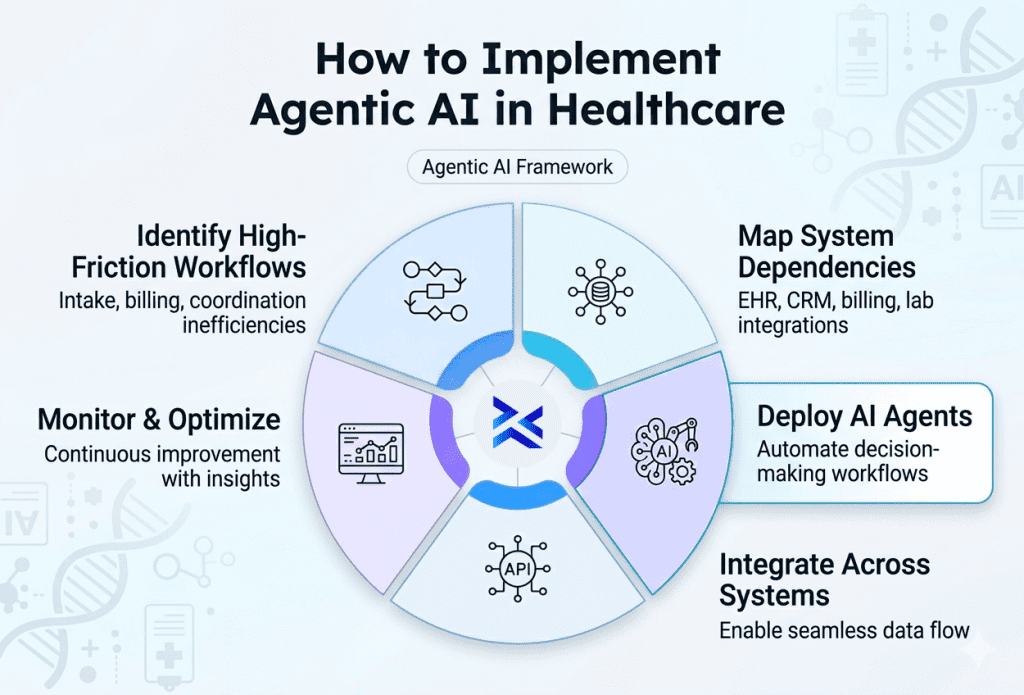
How to Implement Agentic AI in Healthcare (Practical Framework)
The Future: Autonomous Healthcare Operations
Healthcare is moving toward:
- Self-operating workflows
- Predictive operations
- AI-led coordination
Agentic AI will become the backbone of next-generation healthcare systems.
Conclusion
The question is no longer:
👉 Should healthcare adopt AI?
The real question is:
👉 How fast can you move from automation to autonomy?
Organizations adopting Agentic AI are seeing:
🔻 Reduction in operational costs
⚡ Faster patient processing
📈 Improved staff productivity
😊 Enhanced patient experience
This is not incremental improvement.
It’s operational transformation.
FAQ's
Agentic AI refers to autonomous AI systems that can manage workflows, make decisions, and operate across healthcare systems without constant human intervention.
Traditional automation follows predefined rules, while Agentic AI adapts, makes decisions, and orchestrates workflows dynamically.
Patient intake, care coordination, claims processing, clinical workflows, and post-care engagement.
Yes, when implemented with compliance frameworks, security, and human oversight.