AI vs Automation: Key Differences Every Business Leader Must Know
There is a budget conversation happening in boardrooms right now that is going sideways, and the reason is almost always the same.
A CTO or COO walks in with a technology proposal. It mentions “AI-powered automation.” The CFO nods. The CEO approves it. Eighteen months later, the results are underwhelming, and nobody can quite explain why the investment didn’t deliver what was promised.
Often, the diagnosis is straightforward: the organization bought an automation tool when it needed AI, or deployed AI in a context where automation was the right and far simpler answer. The two technologies were treated as interchangeable when they are fundamentally different instruments, built for different categories of business problems.
This confusion is not a symptom of poor judgment. It is the predictable result of a marketplace that has spent the last several years conflating the terms deliberately. Every vendor has rebranded their product as “AI-powered.” Every RPA tool suddenly has a machine learning feature in its marketing. Every workflow platform claims to be “intelligent.”
This guide exists to cut through that noise. It draws a clear line between automation and AI, builds an honest decision framework for when to use each, and explains how the most operationally advanced enterprises are combining both through what the industry is now calling intelligent automation to achieve outcomes that neither technology delivers alone.
What is Traditional Automation?
Before the current generation of AI platforms arrived, enterprises had already spent decades automating. The discipline existed long before any of the modern vocabulary around it, it was called workflow management, process automation, scripting, or simply “making the computer do it.”
Traditional automation, at its core, is the execution of predefined rules. You define the logic. The system executes it. Exactly as designed, every time, without variation.
Rule-Based Automation Explained
Rule-based automation operates on conditional logic: IF this condition is true, THEN perform this action. The entire behavioral scope of the system is determined at design time by whoever configured it. There is no learning, no adaptation, no decision-making beyond what the rules explicitly encode.
This is both the strength and the limitation of traditional automation. The strength is reliability: a rule-based system executes with perfect consistency and is fully auditable. You can predict its behavior with certainty, which matters enormously in regulated industries and compliance-sensitive processes. The limitation is brittleness: the moment a process encounters a condition that was not anticipated in the rule set, the automation fails, escalates, or produces a wrong output and the only remedy is a human intervention or a rules update.
Think of it as a sophisticated flowchart that executes itself. Every branch is predetermined. Every outcome is planned. It is remarkably effective for the right category of work.
Examples: RPA, Scheduled Tasks, and Macros
Traditional automation takes several common forms in enterprise environments:
Robotic Process Automation (RPA) deploys software “bots” that mimic user interactions with digital interfaces logging into applications, copying data between systems, filling forms, generating reports. RPA became widely adopted because it could automate tasks in existing legacy systems without requiring API integrations or systems redesign. Its limitation is significant: RPA is fragile in the face of interface changes, and it cannot interpret data it has not been explicitly programmed to recognize.
Scheduled tasks and batch processing automate operations that run at defined intervals nightly data exports, weekly payroll calculations, monthly report generation, daily backup routines. These are among the most mature forms of enterprise automation, operating reliably in the background of almost every organization’s technical infrastructure.
Macros and scripts automate sequences of actions within applications the Excel macro that reformats and aggregates a dataset, the script that pulls data from one system and pushes it to another. These are typically low-cost to build, high-value for individual productivity, but difficult to govern at enterprise scale.
What unites all of these is that they are fundamentally execution tools. They do not understand the work they are performing. They cannot recognize when the process has changed or when the output they are producing is wrong. And they are only as intelligent as the person who designed them.
What is Artificial Intelligence (AI)?
Artificial intelligence is not a single technology. It is a category of technologies that share a common defining characteristic: they derive their behavior from data rather than explicit rules. Where automation is programmed, AI is trained.
Machine Learning, NLP, and Decision Intelligence
The practical components of AI that matter most to enterprise leaders fall into three categories:
Machine learning (ML) is the foundation. ML algorithms identify patterns in historical data and use those patterns to make predictions or classifications on new data. A fraud detection model learns from millions of historical transactions including the ones that turned out to be fraudulent and uses that learned pattern to assess the risk of any new transaction. It was never told “a transaction over $5,000 at 3 AM from an unfamiliar location is suspicious.” It discovered that relationship from the data itself.
Natural Language Processing (NLP) enables AI systems to read, interpret, and generate human language including the unstructured text that makes up the majority of enterprise data: emails, contracts, support tickets, clinical notes, customer feedback, and documents of every kind. NLP is what allows an AI system to extract key terms from a supplier contract, classify the sentiment in a customer complaint, or route an incoming email to the correct department based on its content not its metadata.
Decision intelligence is the application of AI to support or make complex decisions that involve multiple variables, uncertainty, and trade-offs. It moves AI from a pattern-recognition tool to a reasoning system one that can weigh inputs, assess probabilities, and recommend or execute actions that optimize for defined objectives. This is the foundation of the more advanced applications enterprises are now pursuing.
How AI Learns vs. How Automation Follows Rules
The conceptual difference between AI and automation is the difference between a new employee who was given a manual on day one and an experienced professional who has been doing the job for ten years.
The new employee with the manual will follow the procedures exactly as written. If the manual doesn’t cover a situation, they will stop and ask. Give them the same input twice and they will produce the same output both times. This is automation.
The experienced professional brings something the manual cannot capture: judgment developed through pattern recognition over time. They know what a suspicious invoice looks like even if no rule explicitly describes it. They can handle situations the manual never anticipated. They get better at the job the longer they do it. This is AI.
The practical implication for enterprise leaders: automation delivers consistency within defined boundaries. AI extends what is automatable beyond those boundaries into the territory where work requires interpretation, judgment, or adaptation.
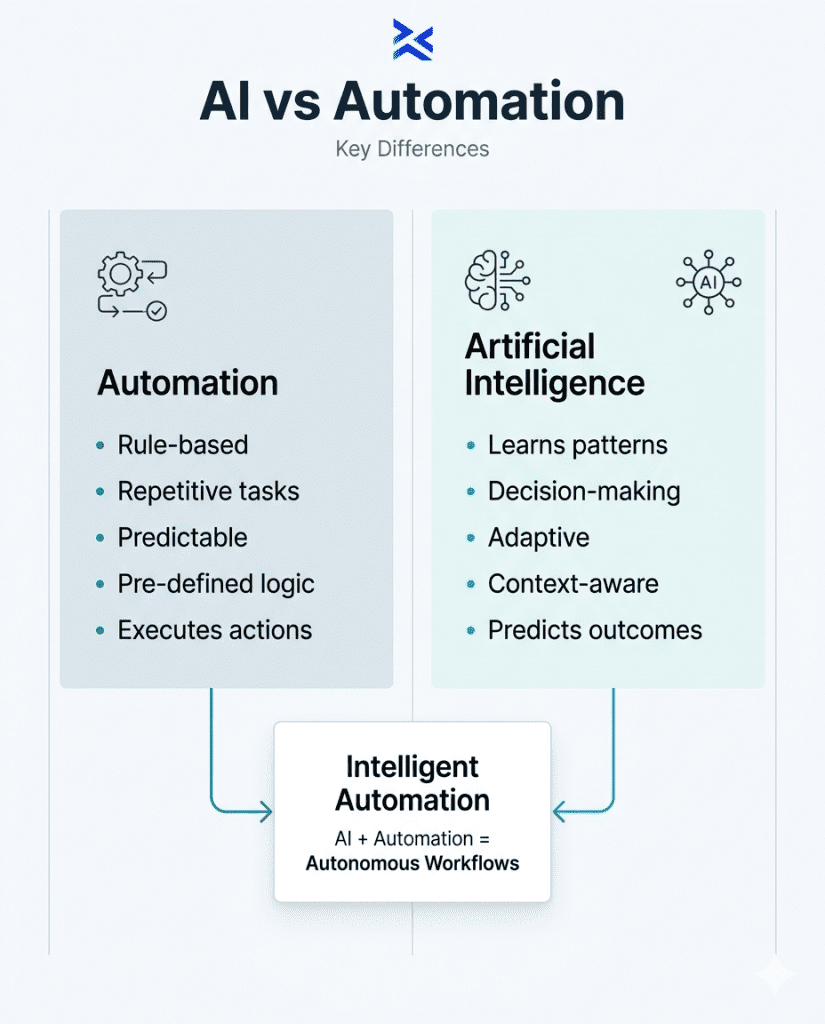
Dimension | Traditional Automation | Artificial Intelligence |
How it operates | Follows predefined rules | Learns from data and adapts |
Input requirements | Structured, consistent data | Structured or unstructured data |
Output predictability | Fully deterministic | Probabilistic / context-dependent |
Handles exceptions | No – escalates or fails | Yes – can reason through novel scenarios |
Improves over time | No | Yes – with feedback and new data |
Implementation speed | Fast | Slower (training/tuning required) |
Cost of entry | Lower | Higher |
Best for | Repetitive, rule-defined tasks | Judgment, patterns, predictions |
AI vs Automation : Side-by-Side Comparison Table
The table above captures the technical dimensions. But for business leaders making investment decisions, the practical framing matters more. Here is the decision-level comparison:
Business Scenario | Right Tool | Why |
Routing an invoice through a 3-step approval based on spend tier | Automation | Logic is fully defined, inputs are structured |
Extracting line items from invoices that arrive in different formats | AI | Unstructured input, format variation requires interpretation |
Sending a payment confirmation email when an invoice is approved | Automation | Trigger and action are fully predictable |
Predicting which invoices are likely to contain errors before processing | AI | Pattern recognition across historical data |
Onboarding a new employee through a defined checklist of tasks | Automation | Sequential, rule-based, consistent |
Analyzing why new hire attrition spikes in the first 90 days | AI | Pattern detection across multiple variables |
Generating a weekly sales report from CRM data | Automation | Defined data source, defined output structure |
Identifying which sales opportunities are most likely to close this quarter | AI | Predictive modeling on complex behavioral signals |
Triggering a reorder when inventory falls below a threshold | Automation | Rule is defined, threshold is known |
Forecasting next quarter’s demand by SKU across regions | AI | Predictive analytics on historical + external data |
The pattern that emerges from this table is the practical decision rule: automation for what you can fully define in advance; AI for what requires understanding, prediction, or adaptation.
When Should You Use Automation vs AI?
The most expensive mistake enterprises make in this space is not choosing the wrong technology, it is applying the right technology to the wrong problem.
Use Automation For: Predictable, Repetitive Processes
Traditional automation delivers its clearest ROI when deployed against processes that are:
Highly structured. The data inputs are consistent and well-defined. The steps are sequential and fully known. The decision logic can be captured completely in IF-THEN rules without ambiguity.
High-volume and repetitive. The process runs hundreds or thousands of times. The consistency benefit of automation compounds with volume, every manual touchpoint eliminated at scale delivers material cost and time savings.
Change-resistant. The process is stable enough that the rules governing it won’t need to be rewritten frequently. Automation built on rapidly changing logic becomes a maintenance burden that erodes the ROI case.
Compliance-sensitive. Auditability matters. Automation executes exactly what it was designed to execute, with a complete, verifiable record of every action. This is a significant advantage in regulated industries where the ability to demonstrate that a process was followed correctly is not optional.
Payroll processing. Purchase order generation. System access provisioning. Document filing. Report distribution. Password resets. These are the workflows where automation performs definitively and reliably and where the implementation risk is lowest.
Use AI For: Exceptions, Pattern Recognition, and Predictions
AI earns its cost premium when deployed against problems that traditional automation structurally cannot solve:
Unstructured data interpretation. Roughly 80% of enterprise data is unstructured it exists as emails, documents, images, audio, and natural language text. Automation cannot read a supplier contract and extract the payment terms. It cannot classify an incoming customer complaint by issue type based on the written narrative. AI can.
Exception handling at scale. Exceptions are the hidden cost center of most enterprise operations. When an automated process encounters a condition outside its rules, a human steps in. At sufficient volume, the exceptions workflow becomes a full-time function. AI can be trained to handle a significant portion of those exceptions recognizing the pattern of what constitutes a “normal exception” versus a genuinely novel scenario requiring human judgment.
Predictions and forecasts. What automation absolutely cannot do is tell you what is likely to happen. Demand forecasting, churn prediction, fraud scoring, credit risk assessment, predictive maintenance, these are AI territory. The value of acting on a prediction early, rather than reacting to an outcome after the fact, is measurable in margin and operational cost.
Dynamic personalization. Automation can send the same email to 100,000 customers based on a trigger. AI can determine what each of those 100,000 customers actually needs to receive, based on their behavioral history, preferences, and predicted intent and personalize the content accordingly.
The right mental model: automation is your operations layer. AI is your intelligence layer. In the most capable enterprise architectures, they are not alternatives they are sequential. Automation handles the volume. AI handles the complexity.
Intelligent Automation - Where AI and Automation Meet
The most important development in enterprise technology over the past three years is not AI, and it is not automation. It is the convergence of the two into a single operational capability that most of the industry is calling intelligent automation.
Intelligent automation is not a marketing term. It is a structural answer to a real architectural problem: the processes that deliver the most business value are rarely purely structured or purely unstructured. They involve both. And the tools that handle one have historically been unable to handle the other.
What is Agentic AI in Business?
The current frontier of intelligent automation is agentic AI – a category that MIT Sloan’s research describes as systems that “can plan, act, and learn on their own” rather than simply responding to instructions.
Traditional AI generates outputs: it classifies, predicts, or recommends. An agentic AI system takes that output and acts on it, across multiple steps, multiple systems, and multiple decisions without requiring a human to orchestrate each action.
The practical distinction is important. A conventional AI model can tell you that an incoming insurance claim has a high probability of containing fraudulent elements. An agentic AI system can: flag the claim, cross-reference it against the claimant’s history in the CRM, pull the relevant policy documents from the document management system, initiate a secondary review workflow with the appropriate specialist queue, generate a structured summary of the anomalies for the reviewer, and update the claim status in the core processing system all autonomously, with a complete audit trail.
BCG’s enterprise research found that early adopters of agentic AI are seeing 20-30% faster workflow cycles and significant reductions in back-office costs, with AI-powered workflows accelerating certain processes by 30-50%. These are not marginal efficiency gains. They represent a structural shift in what is automatable.
It is important to be realistic about where the technology currently sits. Deloitte’s 2025 research found that while 38% of organizations are piloting agentic AI solutions, only 11% are actively using them in production at scale. The gap between pilot and production remains significant, largely due to data quality requirements, legacy system integration challenges, and the governance frameworks needed to deploy autonomous systems responsibly. Organizations that treat agentic AI as a production capability today need strong data foundations, clear human oversight protocols, and a phased deployment approach that starts with high-value, bounded use cases.
How Tentoro Combines AI + Automation in One Platform
The operational challenge that most enterprises face is not a shortage of automation tools or AI models. It is the absence of a platform that lets both work together natively, in the same workflow, without requiring a separate integration project every time an AI capability needs to be connected to an automation layer.
Tentoro was built as a unified intelligent automation platform: a no-code workflow builder where traditional rule-based automation and AI agents operate within the same canvas, under the same governance model, deployed by the same business teams.
In practice, this means an operations manager can build a workflow that uses automation for the structured, predictable portions of a process approval routing, system updates, notification triggers while embedding AI agents at the decision points where the process encounters variability: extracting data from inconsistent documents, classifying incoming requests by intent, handling exceptions that fall outside the standard routing logic.
The two capabilities do not require separate deployment, separate governance, or separate technical teams. They are part of the same process design experience. This is the architecture that makes intelligent automation operationally viable at enterprise scale not as a future roadmap item, but as a workflow that a procurement manager can build and deploy this week.
Real Business Examples: AI + Automation in Action
Theory is useful. What converts a CTO is seeing the model applied to a process that looks like their own.
Healthcare: AI Triage + Automated Patient Routing
A regional hospital network receives hundreds of patient intake requests daily across multiple channels phone, portal, email, and referral fax. The traditional model requires a triage team to manually review each incoming request, assess acuity, and route it to the appropriate care pathway. It is slow, inconsistent, and dependent on the availability of experienced staff.
With intelligent automation: AI processes each incoming intake request reading the free-text clinical notes, extracting symptom information, and scoring the case against acuity criteria. High-acuity cases trigger an immediate automated notification to the on-call clinical team with a structured summary. Standard cases route automatically into the appropriate department scheduling queue, with patient confirmation communications sent simultaneously. Referral documents are automatically matched to existing patient records or new patient workflows are initiated. The triage team’s human attention is reserved for the genuinely complex edge cases not the majority of requests that fit recognized patterns.
The outcome is faster care routing, reduced administrative burden on clinical staff, and a consistent patient experience regardless of intake channel or time of day.
Manufacturing: AI Quality Prediction + Automated Alerts
A precision manufacturing facility runs continuous production across multiple lines. Quality inspection occurs at defined checkpoints in the process, but defects are typically identified after the fact after substandard components have moved downstream in the production sequence.
With intelligent automation: machine sensor data, production parameters, and historical defect records feed continuously into an AI model trained to recognize the leading indicators of quality failures, specific combinations of temperature deviation, pressure variance, and feed rate that have historically preceded defect events. When the model detects a high-probability defect signal, it automatically triggers: a production line alert to the floor supervisor, a hold instruction to the downstream assembly station, a quality investigation task assigned to the QA team with all relevant sensor data attached, and a root cause analysis workflow that correlates the anomaly against recent material batch data and equipment calibration records.
The shift from reactive to predictive quality management is not an incremental improvement. It changes the economics of quality control, defects caught before they occur rather than after they have propagated through the production sequence.
Retail: AI Demand Forecasting + Automated Replenishment
A multi-channel retail operation manages thousands of SKUs across regional distribution centers and store locations. Inventory replenishment is triggered by reorder thresholds, when stock falls below a defined level, a replenishment order fires. This model works for stable demand but fails predictably around promotions, seasonality, and demand signals that precede observed stock movements.
With intelligent automation: an AI demand forecasting model analyzes historical sales velocity, promotional calendars, regional trend data, and external signals weather patterns, local events, social media purchase intent signals to generate forward-looking demand projections at the SKU-location level. These projections feed directly into the automated replenishment workflow, which adjusts order quantities and timing based on forecast demand rather than observed depletion. When a forecasted demand spike is identified, replenishment orders are automatically accelerated. When a forecasted demand decline is detected, order quantities are automatically reduced before excess inventory accumulates.
The result is a replenishment system that anticipates demand rather than reacting to it reducing both stockout events and carrying costs simultaneously.
Common Myths About AI vs Automation — Debunked
The confusion in this space is not random. It is actively manufactured by marketing language and reinforced by several persistent myths that deserve to be addressed directly.
Myth 1: “AI will replace automation.” This is wrong, and it reveals a misunderstanding of what automation is for. AI does not replace predictable, rule-based execution, it extends what is automatable beyond where rules can reach. Enterprises deploying AI at scale still rely on automation as the operational backbone of their processes. The two technologies are complementary, not competitive.
Myth 2: “RPA is AI.” RPA vendors invested heavily in AI branding over the past several years. The addition of a computer vision module or a machine learning classifier to an RPA platform does not make the platform AI. RPA is fundamentally automation, it executes instructions. The AI capabilities bolted onto it are narrow and typically require significant configuration to apply to specific use cases. This distinction matters when you are evaluating whether a platform can genuinely handle unstructured data and exception management at scale.
Myth 3: “You need AI before you need automation.” Most organizations have the opposite problem: they have too much manual work that should have been automated years ago, and they are considering AI investments before the operational foundation is in place to absorb and act on AI-generated outputs. Automation creates the reliable execution layer that makes AI investment worthwhile. Get the workflows structured first. Then make them intelligent.
Myth 4: “AI is too complex and expensive for most enterprises.” This was true in 2019. It is not true today. The emergence of no-code intelligent automation platforms, which embed AI capabilities that previously required data science teams to build and maintain has democratized access to production-grade AI for enterprise operations teams. A procurement manager does not need to understand how a machine learning model works to deploy one in a workflow that classifies incoming vendor invoices.
Myth 5: “Automation is good enough, AI is just a buzzword.” For processes involving structured data and predictable logic, automation is not just “good enough”, it is the correct tool. But the processes that are currently consuming the most human time in most enterprises are not those processes. They are the ones that involve judgment: reviewing documents, handling exceptions, making routing decisions on ambiguous requests, predicting outcomes. For these, automation is categorically insufficient. Calling AI a buzzword in this context is the equivalent of calling GPS a buzzword because paper maps were already working.
How to Build an AI-Augmented Automation Strategy
The strategic question is not “should we use AI or automation?” It is “how do we build a process infrastructure that deploys each technology in the context where it delivers maximum value?”
Here is the framework that consistently produces the best outcomes for enterprise operations teams.
Step 1: Map your processes by type, not by department. The first move is a structured inventory of your most time-consuming, high-volume processes across all functions. For each process, classify it: is it primarily structured and rule-based, or does it involve unstructured inputs, exceptions, and judgment? This classification determines which technology layer to apply. Do not let the org chart determine your automation strategy. A procurement process and a customer service process in different departments may have the same automation profile.
Step 2: Automate the structured backbone first. Before deploying AI, build reliable automated workflows for the predictable core of your high-priority processes. This accomplishes two things: it delivers immediate ROI from automation, and it creates the structured execution layer that AI capabilities will plug into. AI that has to operate in an environment of manual, inconsistent processes is constrained in its impact. AI that operates within a well-automated environment compounds it.
Step 3: Identify the AI insertion points. For each automated workflow, map the moments where the process currently requires a human because the work involves interpretation, pattern recognition, or judgment. These are your AI insertion points. These might be: the moment where a document needs to be read and data extracted; the routing decision that depends on the content of a request rather than its source; the exception that doesn’t fit the standard rules; the prediction that should inform the next workflow step.
Step 4: Start with the highest-value, most bounded AI use cases. Resist the temptation to pilot AI in the most complex process in your organization. The highest success rate for AI deployment comes from use cases that are high-volume, consequential, and have clear, measurable outputs. Invoice data extraction. Support ticket classification. Document type identification. These are not glamorous use cases, but they demonstrate value quickly, build organizational confidence, and create the data flywheel that makes more complex AI applications viable.
Step 5: Build governance before you scale. The production failure mode for intelligent automation is not technical, it is governance. Organizations that deploy AI agents at scale without role-based access controls, audit logging, human-in-the-loop escalation paths, and performance monitoring frameworks discover this the hard way. McKinsey’s research identifies data quality and governance as the primary barriers to scaling agentic AI. Build the governance infrastructure at the same time as the first production deployment, not after the problems appear.
Step 6: Measure and improve continuously. Automation performance metrics are straightforward: did the workflow execute, how long did it take, how many exceptions occurred? AI performance metrics require a different discipline: is the model’s accuracy holding, are there categories of inputs where it is underperforming, has the underlying data distribution shifted in ways that are degrading model relevance? Build the monitoring discipline in from the start. The organizations that capture compounding value from AI + automation are the ones that treat the deployed system as the beginning of the improvement cycle, not the end.
The Strategic Reality for Enterprise Leaders in 2026
The distinction between AI and automation is not academic. It is a capital allocation decision. Enterprises that conflate the two deploy the wrong tool for their problems, invest in the wrong capabilities, and fail to capture the operational returns that the right combination of both technologies can deliver.
The practical conclusions for business leaders are straightforward:
Automation is your operational foundation. It handles the volume, enforces the rules, creates the audit trails, and frees your teams from repetitive execution work. It is not old technology, it is the necessary infrastructure that makes everything else work. For the majority of enterprise processes, it is the correct and sufficient answer.
AI is your intelligence layer. It extends automation into the territory where rules can’t reach: unstructured data, exceptions, predictions, and adaptive decision-making. It does not replace automation. It makes automation smarter at the boundaries.
Intelligent automation, the combination of both, natively integrated in a platform that business teams can operate without deep technical expertise is the operational model that the leading enterprises in every sector are building toward. The gap between organizations that are deploying this model and those that are still debating the theory is widening every quarter.
The question for your organization is not whether to combine AI and automation. It is how quickly you can build the platform and governance infrastructure to do it at scale and whether the tool you choose puts that capability in the hands of the teams who know your processes best.
Conclusion
The AI vs automation debate was always a false choice. The organizations asking “which one should we use?” have been looking at the wrong question. The right question is: “which processes need intelligent execution, and how do we build a platform that delivers both?”
That reframe changes everything about the investment decision. Automation without AI is a ceiling powerful within its limits, but unable to scale into the judgment-dependent work that still consumes enormous operational bandwidth. AI without automation is a compass without legs intelligence that produces outputs but has no reliable execution layer to act on them.
Intelligent automation, where the two operate as a unified capability within a platform that business teams own and operate, is where the real productivity shift lives. Not in a pilot. Not in a proof of concept. In production, at scale, running the processes that actually drive your business.
Tentoro was built for exactly this architecture: a no-code intelligent automation platform where AI agents and traditional workflow automation work side by side deployed by your operations teams, governed by IT, and built to handle the full complexity of enterprise processes without requiring a systems integrator for every workflow update.
FAQ's
Automation executes predefined rules consistently and repeatedly. AI learns from data, recognizes patterns, and makes adaptive decisions that were never explicitly programmed. Give automation the same input twice and it produces the same output both times by design. AI produces outputs that vary based on context, and improves its accuracy as it processes more data. The practical test: if the full logic of a process can be written down as rules in advance, automation is the right tool. If the process involves interpretation, exceptions, or prediction, AI is needed.
Intelligent automation is the combination of rule-based automation and artificial intelligence operating as a unified capability creating systems that execute structured workflows reliably while handling exceptions, unstructured data, and dynamic decisions through AI reasoning. It is not a single product category but an architectural model: automation handles the structured backbone of a process; AI extends the automation into the edges where rules alone are insufficient.
Use automation when processes are predictable, rule-based, and high-volume, where consistency is the objective and the logic can be fully defined. Use AI when processes involve unstructured data, pattern recognition, exceptions that fall outside defined rules, or predictions about future outcomes. In most enterprise environments, the highest-value approach uses both: automation for the structural core of a workflow, AI for the decision points that require intelligence.
Agentic AI refers to AI systems that can plan and execute multi-step tasks autonomously without requiring a human to orchestrate each decision point. Unlike conventional AI, which generates a recommendation or classification, agentic AI takes action: it moves across systems, executes steps, adapts based on what it encounters, and completes a goal end-to-end. In enterprise operations, this looks like an AI system that receives an incoming claim, researches relevant history, initiates the appropriate workflow, generates a summary for a reviewer, and updates all relevant systems without a human triggering each individual step.
No. RPA (Robotic Process Automation) is a form of traditional automation that mimics user interactions with digital interfaces. It follows rules, executes scripts, and does not learn or adapt. Some RPA vendors have added narrow AI capabilities computer vision for reading screen elements, basic NLP for document extraction but these are add-ons to a fundamentally rule-based architecture, not a transformation of it. True AI capability means the system improves with data, handles genuine variability, and can reason about inputs it has never encountered before.
Begin by mapping your highest-volume, most time-consuming processes and classifying them: structured and rule-based vs. involving judgment, unstructured data, or prediction. Automate the structured backbone of your priority processes first this builds your execution layer and delivers fast ROI. Then identify the specific decision points within those processes where AI would extend the automation into exception handling or prediction. Start with high-volume, bounded AI use cases where success is measurable. Build governance infrastructure alongside your first production deployment. Treat deployment as the beginning of a continuous improvement cycle, not the finish line.