10 Real-World Use Cases of Agentic AI in Enterprise Operations
Enterprise AI has a perception problem.
On one side, there’s hype, bold promises of automation, intelligence, and transformation.
On the other, there’s reality, fragmented systems, manual workflows, and operational bottlenecks that refuse to go away.
The gap between the two isn’t capability.
It’s execution.
This is where Agentic AI is quietly changing the rules.
Unlike traditional automation, Agentic AI doesn’t just perform tasks, it understands context, makes decisions, and orchestrates workflows across systems.
And in doing so, it’s redefining how enterprise operations actually run.
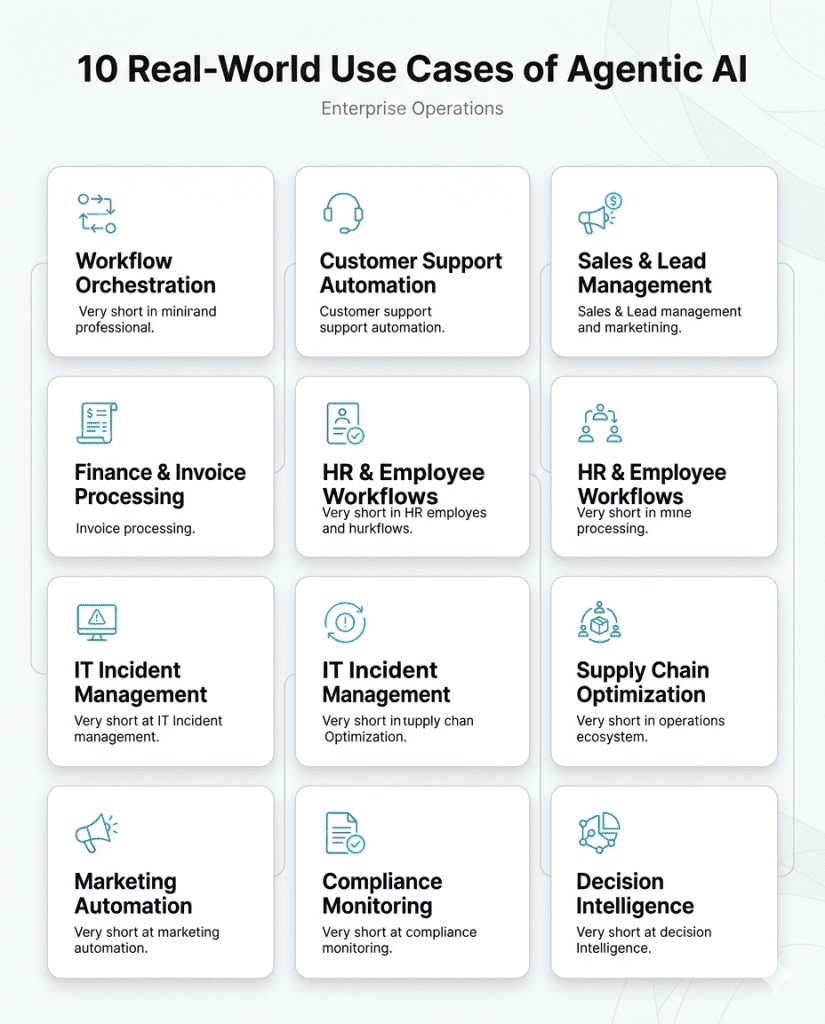
Here are 10 real-world use cases where Agentic AI is already creating measurable impact.
What Makes Agentic AI Different in Enterprise Operations?
Before diving into use cases, one distinction matters:
- Traditional automation → Executes predefined rules
- Agentic AI → Adapts, decides, and coordinates across systems
This shift transforms operations from:
👉 Task-based → Outcome-driven
10 Real-World Use Cases of Agentic AI
1. Intelligent Workflow Orchestration Across Departments
Problem:
Operations are siloed; HR, finance, ops, and support don’t sync efficiently.
Agentic AI in Action:
AI agents coordinate workflows across systems, ensuring tasks trigger automatically across teams.
Impact:
- Reduced delays
- Seamless cross-functional execution
2. Autonomous Customer Support Resolution
Problem:
Support teams handle repetitive queries and escalate unnecessarily.
Agentic AI in Action:
AI agents resolve issues end-to-end, understanding context, accessing systems, and executing actions.
Impact:
- Faster resolution time
- Reduced support workload
3. AI-Driven Sales Operations & Lead Management
Problem:
Leads are lost due to slow follow-ups and poor prioritization.
Agentic AI in Action:
Agents qualify leads, assign priorities, trigger follow-ups, and update CRM systems automatically.
Impact:
- Increased conversion rates
Faster response cycle
4. Finance & Accounts Payable Automation
Problem:
Invoice processing is manual and error-prone.
Agentic AI in Action:
AI agents validate invoices, match records, approve workflows, and flag discrepancies.
Impact:
- Reduced processing time
- Lower financial errors
5. HR & Employee Lifecycle Management
Problem:
Onboarding, approvals, and HR workflows are fragmented.
Agentic AI in Action:
Agents automate onboarding, document collection, approvals, and employee queries.
Impact:
- Improved employee experience
- Reduced HR workload
6. IT Operations & Incident Management
Problem:
IT teams react to issues instead of preventing them.
Agentic AI in Action:
Agents detect anomalies, trigger workflows, resolve incidents, and escalate intelligently.
Impact:
- Faster issue resolution
- Reduced downtime
7. Supply Chain & Logistics Coordination
Problem:
Supply chains are reactive and disconnected.
Agentic AI in Action:
Agents monitor inventory, predict disruptions, and coordinate logistics in real time.
Impact:
- Improved efficiency
- Reduced operational risk
8. Marketing Campaign Execution & Optimization
Problem:
Campaigns require manual coordination across tools.
Agentic AI in Action:
Agents execute campaigns, optimize performance, and adjust targeting dynamically.
Impact:
- Higher ROI
- Faster campaign execution
9. Compliance Monitoring & Risk Management
Problem:
Manual compliance tracking is slow and error-prone.
Agentic AI in Action:
Agents continuously monitor systems, flag risks, and trigger compliance workflows.
Impact:
- Reduced compliance risk
- Faster audits
10. Executive Decision Support Systems
Problem:
Leaders rely on delayed, fragmented data.
Agentic AI in Action:
Agents aggregate insights, analyze patterns, and provide actionable recommendations.
Impact:
- Faster decision-making
- Data-driven leadership
Why These Use Cases Matter Now
Agentic AI is not a future concept.
It’s already:
- Reducing operational costs
- Improving efficiency
- Enabling autonomous workflows
Enterprises that adopt early will gain a compounding advantage.
How to Get Started with Agentic AI
A simple starting framework:
- Identify high-friction workflows
- Map system dependencies
- Deploy AI agents
- Integrate across tools
- Continuously optimize
Conclusion
The question is no longer:
👉 What can AI automate?
The real question is:
👉 What can AI run autonomously?
That’s the shift Agentic AI is driving.
FAQ's
Agentic AI use cases include workflow automation, customer support, finance automation, HR processes, IT operations, and decision-making systems.
Agentic AI is context-aware and autonomous, while traditional automation is rule-based and reactive.
Healthcare, retail, finance, logistics, and manufacturing benefit significantly.
Yes, it is designed to operate across systems and scale with enterprise workflows.