Agentic AI in Finance Operations: Automating Risk, Compliance & Workflows
In most enterprises, finance teams don’t lack tools, they lack time, trust, and adaptability.
Every quarter, billions are spent on ERP systems, compliance software, and reporting tools. Yet CFOs still rely on spreadsheets stitched together at midnight. Risk teams chase anomalies after they’ve already caused damage. Compliance remains reactive, not predictive.
Now, a new paradigm is emerging, one that doesn’t just automate tasks but takes ownership of outcomes.
Welcome to the era of Agentic AI in Finance Operations.
What Is Agentic AI (And Why Finance Needs It Now)
Agentic AI goes beyond automation and traditional AI.
Instead of:
- Executing predefined workflows
- Triggering rule-based actions
Agentic AI systems:
- Understand context
- Make decisions autonomously
- Continuously learn and adapt
- Execute multi-step workflows across systems
👉 Think less “tool” and more “digital finance operator.”
The Real Problem in Finance Ops Today
Before understanding the solution, let’s be clear about the bottlenecks:
| Area | Current Challenge | Business Impact |
|---|---|---|
| Risk Management | Delayed anomaly detection | Financial loss, fraud exposure |
| Compliance | Manual audits & fragmented data | Regulatory penalties |
| Workflows | Siloed systems (ERP, CRM, spreadsheets) | Operational inefficiency |
| Reporting | Lagging insights | Poor decision-making |
Insight: Most “automation” today still depends on human orchestration.
Where Agentic AI Changes the Game
Agentic AI introduces goal-driven execution, not task-based automation.
Traditional Automation vs Agentic AI
| Capability | Traditional Automation | Agentic AI |
|---|---|---|
| Logic | Rule-based | Contextual & adaptive |
| Scope | Single task | Multi-step workflows |
| Decision-making | Human-dependent | Autonomous |
| Learning | Static | Continuous |
Core Use Cases of Agentic AI in Finance Operations
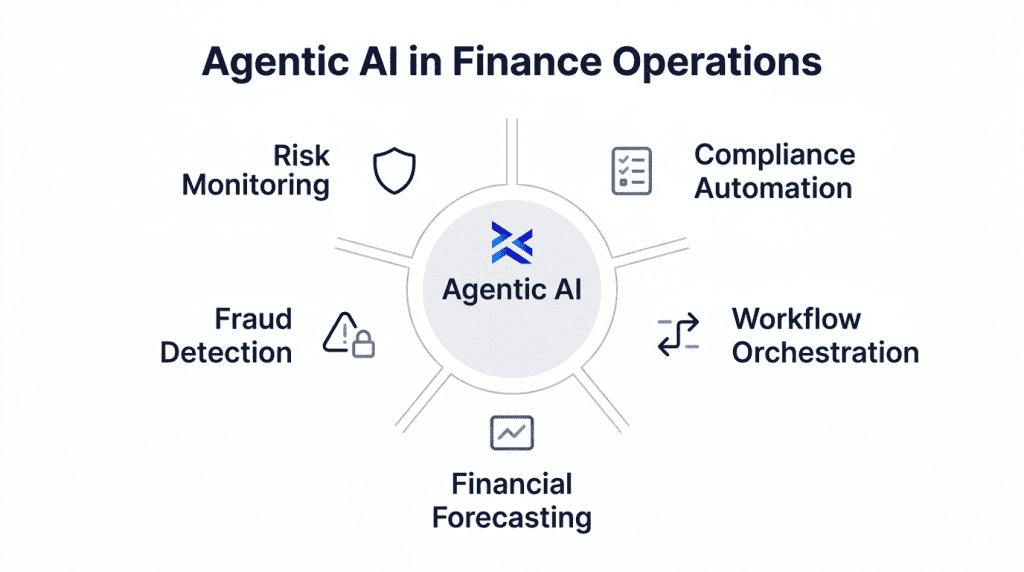
1. Autonomous Risk Monitoring
Problem: Risk teams operate reactively.
Agentic AI Approach:
- Continuously monitors transactions across systems
- Identifies anomalies using behavioral patterns (not just thresholds)
- Takes pre-defined corrective actions automatically
Example:
An AI agent detects unusual vendor payment patterns → pauses transaction → alerts finance → suggests remediation steps.
2. Real-Time Compliance Intelligence
Problem: Compliance is audit-driven, not continuous.
Agentic AI Approach:
- Monitors regulatory changes
- Maps them against internal processes
- Automatically flags non-compliance risks
Impact:
- Reduces audit preparation time by 60–80%
- Minimizes regulatory exposure
3. End-to-End Workflow Automation
Problem: Finance workflows span multiple disconnected tools.
Agentic AI Approach:
- Orchestrates workflows across ERP, CRM, internal tools
- Executes approvals, validations, reconciliations
- Escalates only when needed
Example Workflow:
Invoice received → validated → matched with PO → approved → processed → recorded → reported
(No human intervention unless exception occurs)
4. Intelligent Financial Forecasting
Problem: Forecasts rely on static models.
Agentic AI Approach:
- Continuously ingests internal + external data
- Adjusts forecasts dynamically
- Provides scenario-based recommendations
5. Fraud Detection & Prevention
Problem: Fraud detection happens too late.
Agentic AI Approach:
- Identifies suspicious patterns across vendors, payments, accounts
- Correlates multi-system data
- Takes preventive action before execution
The Enterprise Architecture Shift
Agentic AI is not just a feature—it’s an architectural shift.
From Systems of Record → Systems of Action
- ERP → Stores data
- BI Tools → Visualize data
- Agentic AI → Acts on data
This is where platforms like Tentoro play a critical role:
- Enable no-code/low-code agent creation
- Integrate across enterprise systems
- Deploy AI agents without engineering bottlenecks
A Practical Framework for Adoption
The “3A Framework” for Agentic Finance
1. Augment
Start by assisting human workflows
→ Example: AI-assisted reconciliation
2. Automate
Introduce autonomous execution
→ Example: automated invoice processing
3. Autonomize
Shift to goal-driven agents
→ Example: AI managing end-to-end compliance monitoring
Real-World Business Impact
Organizations adopting Agentic AI in finance are seeing:
- 40–70% reduction in manual operations
- 30–50% faster compliance cycles
- Significant reduction in financial leakage
- Improved audit readiness
What Competitors Get Wrong
Most content around AI in finance focuses on:
- Chatbots
- Predictive analytics
- RPA extensions
What they miss:
- True autonomy
- Cross-system orchestration
- Decision ownership
👉 This is where Tentoro can own the narrative.
The Future: Finance Teams Without Operational Bottlenecks
The finance team of the future:
- Doesn’t chase data
- Doesn’t manually reconcile systems
- Doesn’t react to risk
Instead:
- AI agents monitor, decide, and act
- Humans focus on strategy, not operations
Conclusion
Agentic AI is not an incremental upgrade.
It’s a fundamental shift from:
“Humans managing systems” to “AI agents managing financial operations—with human oversight.”
For enterprises, the question is no longer:
“Should we adopt AI?”
But:
“How quickly can we move from automation to autonomy?”
FAQ's
Agentic AI refers to AI systems that can autonomously execute finance operations, make decisions, and manage workflows across systems without constant human intervention.
RPA follows predefined rules, while Agentic AI adapts, learns, and makes decisions based on real-time data and context.
Yes, it enables continuous monitoring, automatic detection of regulatory gaps, and proactive compliance management.
Yes, especially for enterprises with complex workflows, multiple systems, and high compliance requirements.