Benefits of Low-Code No-Code Platforms: The Definitive Enterprise Guide
There is a quiet crisis running through most enterprise IT organizations that nobody puts in the board presentation but everyone in the building understands.
The backlog of digital requests — new applications, process automations, workflow improvements, reporting tools, grows faster than any development team can address it. The average enterprise has hundreds of internal process problems that a software solution would fix. The development team has bandwidth to address a fraction of them each year. Everything else waits.
Meanwhile, the business operates on spreadsheets, manual email threads, and workarounds that accumulate complexity and risk the longer they persist.
Low-code and no-code platforms were built specifically to solve this problem and the data from enterprise deployments over the last five years makes a compelling case that they do. The global low-code market reached $37.39 billion in 2025 and is projected to hit $264.40 billion by 2032, growing at a 32.2% compound annual rate. That is not a growth curve driven by hype. It is driven by documented, measurable outcomes at the organizations deploying these platforms.
This guide does not give you a list of features. It gives you 15 specific, data-backed benefits that explain why enterprises from manufacturing to financial services are making low-code platforms the operational foundation of their digital strategy and what each benefit means concretely for a CTO, CIO, or operations leader making an investment decision today.
What Are Low-Code and No-Code Platforms?
Before examining the benefits, a precise definition prevents the confusion that plagues most conversations about this category.
A low-code platform is a development environment that uses visual interfaces, drag-and-drop components, and pre-built modules to accelerate application development. It reduces but does not eliminate hand-written code. The primary audience is developers and technically proficient users who want to build faster, and business analysts who can configure applications independently for standard use cases.
A no-code platform goes a step further: it removes the code requirement entirely. Every aspect of the application data structure, user interface, business logic, workflow automation is configured through visual tools. The target audience is business users with no technical background who need to solve operational problems without raising an IT ticket.
Low-Code vs No-Code Key Differences
Dimension | Low-Code | No-Code |
Primary user | Developers, technical users | Business users, operations teams |
Code requirement | Minimal, optional | None |
Customization ceiling | High extend with custom code | Medium within platform guardrails |
Time to deployment | Days to weeks | Hours to days |
Governance model | IT-led with business collaboration | Business-led with IT oversight |
Best for | Complex enterprise apps | Departmental processes, workflows |
Who Uses Each Type
In practice, the boundary between low-code and no-code has blurred significantly. The most capable enterprise platforms including Tentoro offer both modes within the same environment. IT teams use low-code capabilities for complex system integrations and custom logic. Business operations teams use no-code capabilities to build and modify their own workflows and applications independently. Both groups work within the same governance framework, on the same platform, without the friction of separate tools and separate deployment pipelines.
Gartner projects that by 2026, 80% of low-code users will come from outside the IT department which is precisely the model that the highest-performing enterprise deployments already reflect.
15 Business Benefits of Low-Code No-Code Development
1. 10x Faster Application Development
The speed advantage of low-code development over traditional software development is not marginal. Low-code platforms can reduce development time by up to 90% compared to traditional coding methods, with 72% of users developing applications in three months or less.
The mechanism is straightforward: pre-built UI components, visual workflow builders, native integration connectors, and automated testing eliminate the majority of the work that makes traditional development slow. A procurement approval application that would take a developer team three months to design, build, test, and deploy can be operational in days on a low-code platform.
The compounding benefit is what makes this strategically significant. When individual applications take weeks instead of months, the organization’s ability to respond to new business requirements changes structurally. Process problems that previously had to wait 18 months in the backlog can be addressed this quarter.
2. Reduced Dependency on IT and Developers
The IT backlog is not a resource problem it is an architectural problem. The model in which every business process improvement requires an IT development ticket creates a structural bottleneck that no amount of developer hiring fully resolves.
72% of IT leaders report being blocked from strategic work due to project backlogs. Low-code no-code platforms attack this problem at the root by enabling business teams to build and operate their own applications without IT involvement for routine deployments.
The result is not that IT becomes irrelevant. IT’s role evolves: from being the builder of every application to being the architect and governor of the platform that enables business teams to build for themselves. 80% of organizations use low-code tools to free their developers for higher-level, more complex projects. That is a productivity gain for the IT function and a speed gain for the business simultaneously.
3. Lower Total Cost of Ownership
The total cost of traditional enterprise application development is chronically underestimated. The visible cost developer time and licensing is only a fraction of the real number. Add the cost of requirements documentation, QA, deployment, ongoing maintenance, and the opportunity cost of what those developers were not building, and the true figure is substantially higher.
Low-code platforms slash software development costs by 40% to 70% compared to traditional methods, with CIOs reporting 206–260% ROI within three years. Organizations save an average of $187,000 annually after implementing no-code platforms, with 60% of companies reporting annual savings between $100,000 and $200,000.
The post-deployment maintenance cost reduction is equally significant. Post-deployment maintenance costs can drop by up to 60% compared to traditionally coded applications, because visual platform applications are modified through configuration rather than code changes meaning a business analyst can update a workflow rule without filing a development ticket, testing in a staging environment, and coordinating a production deployment.
4. Citizen Developer Empowerment
The concept of the “citizen developer” a business user who builds applications as part of their role, not as their primary function is no longer a theoretical future state. It is a measurable present reality with documented outcomes.
As of 2025, 41% of businesses have active citizen development programs where non-developers are building apps and tools for business needs, with another 20% planning to launch or evaluate one. Within the first year of starting a citizen development initiative, around 79% of businesses successfully build and launch at least one web application.
The strategic value of citizen development is not just efficiency it is organizational intelligence. The people closest to a process problem are the best positioned to design its solution. When a procurement manager, HR business partner, or operations analyst can build the application that solves their own process problem, the quality of the solution improves alongside the speed of delivery. The knowledge that lives in their experience gets built into the application rather than being lost in translation through a requirements document.
5. Automated Business Process Management
Manual business processes the ones currently running on email chains, shared spreadsheets, and tribal knowledge represent the largest category of operational inefficiency in most enterprises. Low-code no-code platforms address this directly through built-in workflow automation that requires no programming to deploy.
Approximately 52% of businesses employ low-code platforms for workflow automation, streamlining repetitive tasks and enhancing operational efficiency. The applications that emerge from these deployments are not just digitized versions of manual processes. They are structurally improved processes with enforced sequencing, automated notifications, conditional routing, SLA monitoring, and exception handling that the manual version never had.
A procurement approval process that previously lived in email becomes an automated workflow with defined approvers, conditional thresholds, escalation paths, and a complete audit trail. The process does not just move faster it moves correctly, consistently, and with full visibility.
6. Real-Time Data Visibility and Reporting
One of the most consistently undervalued benefits of moving from spreadsheet and email-based processes to low-code applications is the shift from retrospective to real-time operational data.
Spreadsheet-based processes produce reports that reflect the state of the business as of the last time someone updated a cell. Low-code applications produce live dashboards that reflect the current state of every process, every approval queue, every inventory level, and every project status because every interaction with the application updates the underlying data immediately.
For senior decision-makers, this changes the nature of operational review from investigating what happened to understanding what is happening. For department managers, it eliminates the data collection step that currently consumes a significant portion of every reporting cycle. The information is always current, always accessible, and always consistent because it comes from a single source of truth rather than a collection of individually maintained files.
7. Enterprise-Grade Security and Governance
The security objection to low-code platforms that they sacrifice governance for speed reflects an older generation of consumer-grade no-code tools, not the current state of enterprise platforms.
Modern enterprise low-code no-code platforms are built with security architectures that match or exceed what most organizations could implement in custom-built applications. Standard enterprise capabilities include role-based access controls at the field and record level, data encryption at rest and in transit, complete audit logging of every user action, SOC 2 Type II certification, ISO 27001 compliance, and GDPR and HIPAA support for regulated industries.
The governance advantage of a well-configured low-code platform over a proliferating landscape of spreadsheets and point solutions is significant. IT can set platform-level rules data access policies, integration permissions, deployment standards within which business teams operate freely. The alternative business teams building their own solutions outside any governed platform is the shadow IT problem that every enterprise is trying to solve, not create.
8. Seamless ERP and CRM Integration
Enterprise applications do not generate value in isolation. Their value is proportional to how deeply they are connected to the systems ERP, CRM, HRMS, document management, communication platforms that the business already runs on.
Enterprise low-code platforms provide pre-built native connectors to the major systems in the enterprise technology stack: SAP, Oracle, Salesforce, Microsoft 365, Workday, ServiceNow, and hundreds more. These connectors handle authentication, data mapping, and API rate management the implementation complexity that makes custom integrations expensive and fragile.
The practical outcome is that a low-code application built for procurement can pull approved vendor lists from the ERP, push approved purchase orders back to the financial system, and notify procurement owners in their existing communication tool all configured visually, without a systems integration project. This depth of connectivity is what separates enterprise-grade platforms from departmental tools, and it is a non-negotiable capability for applications that need to operate within a real enterprise technology environment.
9. Mobile-First Application Delivery
Spreadsheets are clumsy on phones this is not a matter of user preference, it is a structural limitation. The majority of field operations work inspections, inventory counts, service calls, site surveys, delivery confirmations is done by people who are not sitting at a desk. Processes that require desktop access create delays, workarounds, and data quality problems at every step where a field worker needs to interact with a system.
Low-code no-code platforms deploy to mobile browsers and native mobile clients as part of the standard deployment process. The same application that works on a desktop works on a field worker’s phone with responsive layouts, offline data capture for low-connectivity environments, camera integration for photo documentation, signature capture, and barcode scanning. No separate mobile development project. No app store submission cycle.
For organizations running field operations in manufacturing, logistics, construction, healthcare, or retail, mobile-first application delivery is not a convenience feature. It is the capability that determines whether an operational application is actually used or whether it is circumvented by whatever workaround the field team finds more convenient.
10. Rapid Iteration and Continuous Improvement
Traditional software development’s change management process requirements documentation, sprint planning, development, testing, staging deployment, production release creates a significant barrier to improving applications after they are deployed. The result is that applications calcify: they reflect the requirements of the moment they were built, not the operational reality of the current day.
Low-code no-code platforms fundamentally change the cost and speed of making changes to deployed applications. A business analyst can modify a workflow rule, add a new field, change an approval threshold, or update a notification template in the visual builder and redeploy often the same day the need is identified.
This changes the relationship between deployed applications and organizational learning. When improvements are cheap to implement, teams iterate based on what they observe in practice. The application gets better continuously, rather than remaining frozen until the organization accumulates enough requested changes to justify another development project.
11. Elimination of Shadow IT
Shadow IT the applications, tools, and data stores that business teams build and use outside the awareness and governance of IT is one of the most persistent security and operational risks in enterprise organizations. It emerges not because business teams are careless, but because their needs are not being met through governed channels.
When the alternative to building something in Excel or a consumer cloud tool is a 12-month wait for an IT project, business teams will build their own solutions. Low-code no-code platforms eliminate the conditions that make shadow IT rational by giving business teams a governed, supported path to solving their own process problems.
By 2025, nearly 60% of custom apps will be created by employees outside the IT department. The governance question is not whether business teams will build their own applications they already are. The question is whether they will do it on a governed platform with IT visibility and security controls, or in the ungoverned tools where IT has no oversight whatsoever.
12. Built-In Compliance and Audit Trails
For enterprises in regulated industries financial services, healthcare, insurance, manufacturing with quality certifications compliance documentation is not an optional feature. It is an operational requirement that every process-supporting application must meet.
Traditional spreadsheet and email-based processes fail this requirement categorically. There is no reliable, tamper-evident record of who approved what, when, with what information available to them. Reconstructing the history of a decision from email archives is time-consuming, incomplete, and legally precarious.
Low-code no-code platform applications produce complete, automatically generated audit trails as a byproduct of normal operation. Every workflow step executed, every approval granted or rejected, every field modified, every record accessed is logged with a timestamp and user identity. This documentation is available in real time not assembled retroactively for a compliance review and it is stored in a format that survives personnel changes and system upgrades.
For a CTO or compliance officer, this is not a marginal benefit. It is a risk reduction that eliminates a category of compliance exposure that most organizations are currently carrying without fully understanding the liability.
13. AI-Augmented Development Capabilities
The integration of artificial intelligence into low-code no-code platforms is accelerating at a rate that is changing what these platforms can do faster than most enterprise evaluations account for.
The current generation of AI-augmented low-code platforms offers capabilities that were not commercially available three years ago: natural language workflow generation (describe a process in plain language, the platform generates the initial workflow structure), intelligent document processing (extract structured data from unstructured documents as part of a workflow), AI agents that execute multi-step tasks autonomously within a workflow, and predictive analytics embedded directly in operational applications.
AI integration in low-code platforms is expected to generate over $50 billion in enterprise efficiency gains by 2030, with 80% of all business applications developed using AI-powered low-code platforms by 2029.
For enterprise leaders, this trajectory has a strategic implication that goes beyond the current feature set. Organizations that are building their application and automation foundation on modern low-code platforms are positioned to inherit these AI capabilities as they mature without rebuilding their operational infrastructure. Organizations that are still running processes on spreadsheets and legacy point solutions will face a structural rearchitecting requirement at the moment they want to deploy AI at operational scale.
14. Scalability Without Re-Architecture
One of the most consequential limitations of custom-built applications and spreadsheet-based processes is that they do not scale gracefully. An application built for 20 users often requires significant rearchitecting to handle 200. A spreadsheet-based process that works for one geography breaks down when it needs to operate across five. The growth of the business creates a requirement for systems redesign that disrupts operations and consumes engineering resources at the moments they are most in demand.
Enterprise low-code platforms are built on cloud infrastructure designed for scale: horizontal scaling, microservices architectures, and multi-tenant data management that handles growth in users, data volume, and transaction throughput without requiring application redesign. An inventory management app that your warehouse team deploys for 50 users today can scale to 5,000 users across multiple regions without architectural changes.
Enterprise platforms handle massive scale through horizontal scaling and microservices architectures, with AWS, Azure, and Google Cloud infrastructure providing auto-scaling that ensures performance during traffic spikes without manual intervention. This is infrastructure investment that most organizations cannot justify building for individual internal applications but that a low-code platform delivers as a shared capability across every application deployed on it.
15. Measurable ROI Within Weeks
For every other item on this list, the measurement is eventually quantitative. But the speed with which the financial return from a low-code deployment becomes visible is itself a benefit worth stating explicitly because it changes how the investment conversation works at the executive level.
Forrester’s Total Economic Impact study found organizations achieving 506% ROI over three years when transitioning from traditional to low-code development, with most organizations reaching break-even within 6–12 months. Ricoh achieved a 253% ROI in seven months through replacing legacy systems with low-code solutions. Schneider Electric deployed 60 applications in 20 months and realized ROI in seven months.
The mechanism is straightforward: the applications that deliver the fastest ROI are not the complex, multi-year transformation initiatives. They are the high-volume, labor-intensive manual processes approvals, data collection, status tracking, exception management where labor cost per process execution is high and the operational disruption of manual failures is frequent. These are precisely the processes that low-code no-code platforms address first, best, and fastest.
Low-Code vs. Traditional Development — Cost & Time Comparison
The comparison between low-code and traditional development is often presented as a trade-off between speed and capability. This framing is outdated and misleading for the majority of enterprise use cases.
| Dimension | Traditional Development | Low-Code No-Code |
|---|---|---|
| Time to first deployment | 6–18 months | Days to weeks |
| Development cost | $150,000–$500,000+ per application | $10,000–$50,000 equivalent per application |
| Annual maintenance cost | 15–25% of development cost | Significantly lower config changes, not code |
| Change request lead time | Weeks to months | Hours to days |
| Who can modify | Developer team only | Business teams + IT |
| 3-year ROI | Variable, often negative for internal tools | 206–506% (Forrester, multiple studies) |
| Scalability | Re-architecture required | Platform-managed, auto-scaling |
| Integration speed | Weeks per integration | Hours with native connectors |
The capability gap argument that traditional development produces more sophisticated applications is valid for a narrow category of enterprise applications: core systems of record, high-performance transactional engines, proprietary algorithmic platforms. For the category of operational applications that enterprises need in volume workflow tools, approval systems, data collection apps, reporting dashboards, process automation low-code platforms now deliver equivalent or superior functional outcomes at a fraction of the cost and timeline.
The decision framework is clear: use traditional development for systems where maximum custom control over every architectural decision is a business requirement. Use low-code for the operational layer which represents the majority of application needs in most enterprises.
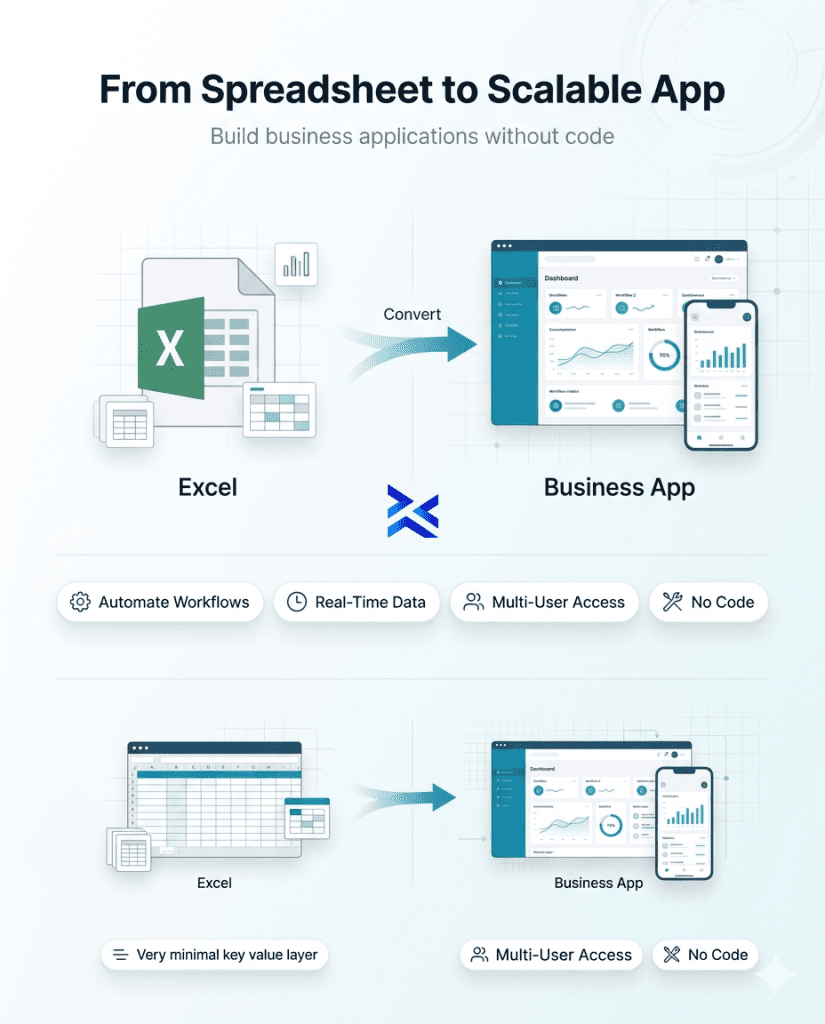
Gartner's View: Why 75% of New Apps Will Be Low-Code by 2026
Gartner’s projections for the low-code market are not modest. Gartner projects that 75% of new enterprise applications will be built on low-code by 2026, with 80% of low-code users coming from outside IT, and 80% of mission-critical applications expected to run on low-code by 2029.
These numbers deserve unpacking, because they represent a more fundamental shift than most enterprise technology forecasts.
The 75% figure means that low-code will become the default modality for new enterprise application development not an alternative for simple use cases, but the primary approach for the full range of operational applications. Traditional hand-coded development will be reserved for the specific cases where its capabilities are genuinely necessary.
The 80% outside IT figure means that the center of gravity for application development will have shifted from engineering teams to business teams. This is not a prediction about replacing developers it is a prediction about who owns the operational application layer of the enterprise. The answer, increasingly, is the business functions themselves.
The 80% mission-critical applications figure is the one that should recalibrate how enterprise IT leaders think about platform selection today. If mission-critical applications will run on low-code by 2029, the platform governance, security, integration depth, and scalability of the low-code platform chosen now will determine whether that transition is an opportunity or a crisis.
Four forces are driving this convergence: a developer shortage that traditional hiring cannot close, pressure to ship digital initiatives faster than IT can build, the rise of composable and AI-native architectures, and business teams that are now technically literate enough to build their own apps with the right platform.
Organizations that are building their operational infrastructure on enterprise-grade low-code platforms now are not chasing a trend. They are positioning for the architecture that Gartner, Forrester, and IDC all project will define enterprise operations within the next five years.
How Tentoro Delivers All 15 Benefits in One Platform
Most of the benefits documented in this guide are available, to some degree, from multiple vendors in the low-code no-code category. The differentiator is not which platform offers which features in its product marketing it is which platform delivers the full capability set in a single, coherently governed environment, without requiring a separate tool for each use case.
Tentoro was built with a specific thesis: that the most valuable low-code no-code platform for an enterprise is one that unifies the full operational application stack visual app builder, workflow automation, AI agents, enterprise integrations, and governance in a single platform that business teams can operate without IT dependency and IT can govern without losing control.
On development speed: Tentoro’s no-code builder enables business teams to deploy functional applications from templates or from scratch within hours. The visual canvas requires no technical training and no development background.
On AI integration: Unlike platforms that have added AI as a marketing layer over rules-based automation, Tentoro’s AI agents are native to the workflow builder. Business teams can add intelligent document processing, semantic routing, predictive logic, and autonomous agent steps to any workflow within the same visual canvas they use for standard automation.
On enterprise governance: Role-based access controls, complete audit logging, workflow versioning, SLA monitoring, and compliance documentation are core platform capabilities available from the first application deployed, not unlocked in a higher-priced enterprise tier.
On integration depth: Tentoro’s connector library covers the ERP, CRM, HRMS, and communication platforms that enterprise operations actually run on with integration depth that handles production data complexity, not just the simplified scenarios most demos show.
On ROI timeline: The fastest path to measurable return is automating the highest-volume, most labor-intensive manual processes first. Tentoro’s solution library includes pre-built templates for the most common enterprise process automation use cases procurement, HR onboarding, finance reconciliation, quality management which means the first workflows can be deployed and generating measurable savings within days of platform access.
The 15 benefits documented in this guide are not theoretical. They are the outcomes that enterprise operations teams achieve when they deploy a platform that delivers all of them coherently rather than assembling a stack of point solutions that each address one benefit while creating new integration and governance challenges of their own.
Conclusion
The case for low-code no-code platforms in the enterprise is no longer an argument for early adoption. The data, the analyst projections, and the documented outcomes from real deployments make it clear: this is now the mainstream architecture for enterprise operational applications.
The question is not whether your organization will be building on low-code. Gartner, Forrester, and IDC all project that the answer to that question is already decided. The question is whether you will choose a platform that delivers the full enterprise capability set AI, governance, integration depth, scalability in a form that your business teams can actually operate, or whether you will spend the next several years evaluating point solutions that each solve part of the problem while creating new coordination overhead.
The enterprises that are compounding the most operational advantage from this shift are the ones that made the platform decision with a multi-year lens. They chose a platform that their operations teams could start using this quarter and that their IT governance model could support at scale. They built the citizen development infrastructure before the backlog forced the issue. They are now deploying AI capabilities on top of an operational foundation that is ready to support them.
FAQ's
The primary benefits fall into three categories: speed (10x faster development, rapid iteration), cost (40-70% lower development costs, 206-506% three-year ROI), and operational capability (citizen developer empowerment, automated workflows, real-time visibility, built-in compliance). The compounding benefit is that all of these improve simultaneously faster development that costs less and produces better-governed applications than the manual processes it replaces.
Low-code platforms primarily serve developers and technically proficient users who want to build faster using visual interfaces with the option to add custom code. No-code platforms are designed for business users with no technical background, everything is configured visually. Enterprise platforms like Tentoro offer both modes in the same environment, allowing business teams to operate independently while IT retains governance and extends functionality when needed.
Forrester research documents enterprises achieving 506% ROI over three years when transitioning from traditional to low-code development, with payback periods typically under six months. Organizations report average annual savings of $187,000, development costs reduced by 40–70%, and most reaching break-even within 6–12 months of initial deployment. Real-world examples include Ricoh achieving 253% ROI in seven months and Schneider Electric deploying 60 applications in 20 months with ROI realized in seven months.
Enterprise-grade low-code no-code platforms include role-based access controls, data encryption at rest and in transit, complete audit logging, SOC 2 Type II and ISO 27001 certifications, and GDPR and HIPAA compliance support. Security depends on both the platform's capabilities and the governance model the organization configures. Enterprise deployments with proper role-based access and audit logging are typically more secure and more auditable than the spreadsheet and email-based processes they replace.
No-low-code complements traditional development rather than replacing it. Traditional hand-coded development remains the right approach for systems requiring maximum architectural customization, high-performance transactional engines, and proprietary algorithmic platforms. Low-code is the right approach for the operational application layer workflow tools, approval systems, data collection apps, reporting dashboards, process automation which represents the majority of enterprise application needs by volume. Gartner projects 75% of new enterprise applications will be low-code by 2026, with traditional development reserved for the cases where its specific capabilities are genuinely required.