How Manufacturers Are Reducing Costs Using GenAI & Automation
For decades, manufacturing leaders chased cost efficiency through scale, outsourcing, and lean operations.
It worked, until it didn’t.
Supply chains fractured. Labor costs surged. Demand became unpredictable. And suddenly, the old playbook, optimize, outsource, repeat, started breaking down.
Now, a new lever is emerging, not in factories, but in intelligence.
Not robotics alone. Not dashboards.
But Generative AI + Automation working together to actively reduce cost across the value chain.
The shift is subtle, but profound:
From optimizing operations to
Autonomously improving them
The New Cost Equation in Manufacturing
Traditional cost reduction focused on:
- Labor arbitrage
- Process efficiency
- Vendor negotiations
But modern cost pressure comes from:
- Demand volatility
- Inventory misalignment
- Downtime unpredictability
- Compliance overhead
- Decision delays
Insight: The biggest cost isn’t inefficiency—it’s slow, fragmented decision-making.
Where GenAI + Automation Actually Drive Cost Reduction
Most content overhypes AI in manufacturing. Let’s break down where real cost savings are happening today.
5 High-Impact Use Cases Driving Cost Reduction
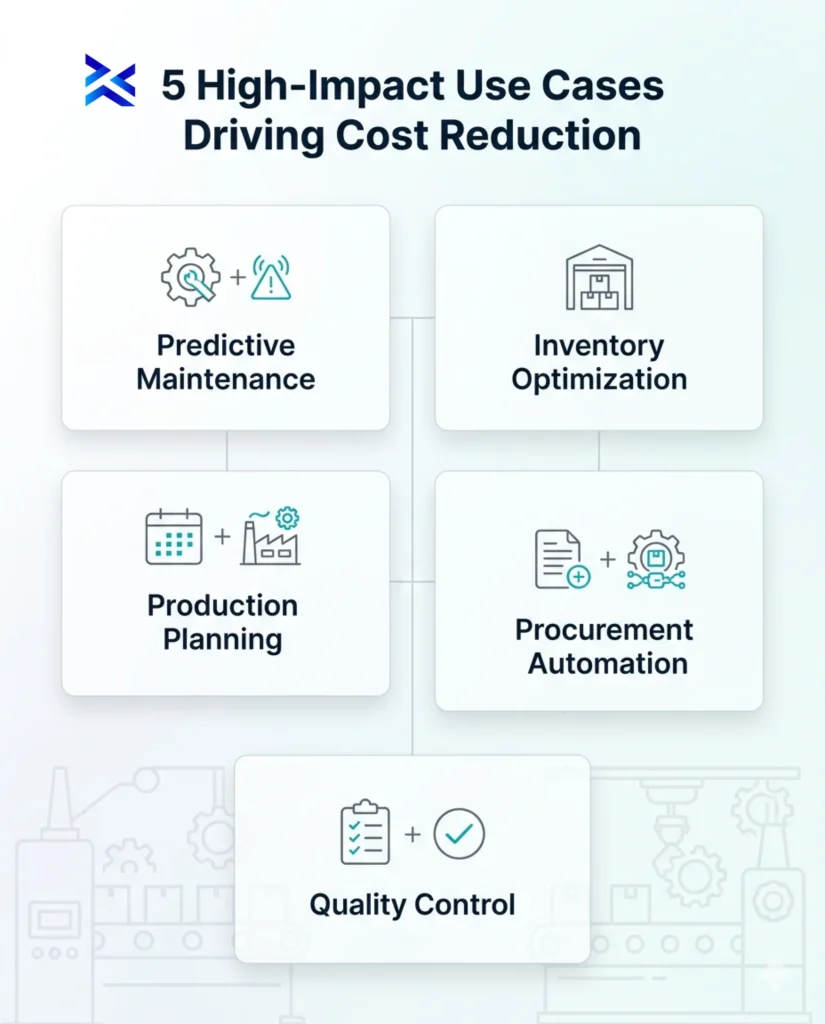
1. Predictive Maintenance → Reducing Downtime Costs
Problem: Equipment failure leads to unplanned downtime.
GenAI + Automation Approach:
- AI models analyze machine data in real time
- Predict failures before they happen
- Automatically trigger maintenance workflows
Cost Impact:
- 20–40% reduction in downtime
- Lower repair costs
- Increased asset lifespan
2. Inventory Optimization → Reducing Holding Costs
Problem: Overstocking or stockouts due to poor forecasting.
GenAI + Automation Approach:
- AI analyzes demand signals, seasonality, and external factors
- Dynamically adjusts inventory levels
- Automates replenishment decisions
Cost Impact:
- Reduced excess inventory
- Improved working capital efficiency
3. Production Planning → Eliminating Inefficiencies
Problem: Static production schedules fail in dynamic environments.
GenAI + Automation Approach:
- AI continuously re-optimizes production schedules
- Adjusts based on demand, supply, and constraints
- Automates scheduling decisions
Cost Impact:
- Higher throughput
- Reduced idle time
- Better resource utilization
4. Procurement Automation → Smarter Vendor Spend
Problem: Manual procurement leads to suboptimal vendor choices.
GenAI + Automation Approach:
- AI evaluates vendor performance, pricing, and risk
- Recommends optimal sourcing strategies
- Automates RFQs and approvals
Cost Impact:
- Lower procurement costs
- Reduced supplier risk
5. Quality Control → Reducing Defect Costs
Problem: Defects lead to rework, waste, and customer dissatisfaction.
GenAI + Automation Approach:
- AI analyzes production data and visual inputs
- Detects anomalies early
- Triggers corrective workflows
Cost Impact:
- Reduced scrap rates
- Improved product quality
- Lower warranty costs
The Real Shift: From Automation to Intelligence
Most manufacturers already use:
- ERP systems
- MES platforms
- Basic automation tools
But these systems:
- Execute tasks
- Don’t think or adapt
GenAI introduces:
- Context-aware decision-making
- Continuous learning
- Cross-system orchestration
Key Insight:
Automation reduces effort.
GenAI reduces wrong decisions.
The Architecture Behind Cost Reduction
From Systems of Record → Systems of Decision
| Layer | Role |
|---|---|
| ERP / MES | Store and manage data |
| BI Tools | Provide visibility |
| Automation | Execute workflows |
| GenAI + AI Agents | Decide and optimize |
This is where platforms like Tentoro enable:
- No-code AI agent deployment
- Integration across manufacturing systems
- Autonomous workflow orchestration
A Practical Framework for Manufacturers
The “Reduce–Optimize–Autonomize” Model
1. Reduce
Automate repetitive manual tasks
→ Example: invoice processing
2. Optimize
Use AI to improve decisions
→ Example: demand forecasting
3. Autonomize
Deploy AI agents to manage processes
→ Example: end-to-end supply chain optimization
Real Business Impact
Manufacturers adopting GenAI + Automation are seeing:
- 15–30% reduction in operational costs
- 20–50% improvement in forecasting accuracy
- Significant reduction in downtime and waste
- Faster decision cycles across operations
What Most Companies Get Wrong
Many organizations:
- Treat GenAI as a chatbot layer
- Focus on isolated use cases
- Ignore workflow integration
Result: Minimal ROI.
The real unlock:
- Integrating AI into core operational workflows
- Moving from tools → autonomous systems
The Future: Self-Optimizing Manufacturing Operations
The next-generation factory:
- Doesn’t rely on static plans
- Doesn’t wait for human intervention
- Doesn’t operate in silos
Instead:
- AI continuously monitors, predicts, and acts
- Systems adapt in real time
- Costs are optimized continuously, not periodically
Conclusion
GenAI in manufacturing isn’t about innovation theater.
It’s about cost discipline at scale.
The winners won’t be those who adopt AI tools.
They’ll be those who embed intelligence into every operational decision. The future of manufacturing isn’t just automated. It’s autonomous, adaptive, and cost-aware by design.
FAQ's
GenAI reduces costs by improving decision-making across production, inventory, and maintenance through predictive insights and automation.
Automation executes predefined tasks, while GenAI adapts, learns, and optimizes decisions in real time.
- Predictive maintenance
- Inventory optimization
- Production planning
- Procurement automation
- Quality control
Yes, especially with no-code platforms that reduce implementation complexity and cost.
Organizations typically see 15–30% cost reduction and significant efficiency gains across operations.